
The Kinship Miracle – Beyond Numbers and Metrics
P. Natarajan2026-11-19T10:41:55+05:30Sometimes, the most meaningful measure of a programme is not what we deliver, but the relationships we build.
For the past four years, the entire Kinship Care team has been meeting online every Monday at 4 pm. This has become something of a ritual, and the schedule rarely changes – except when a Monday happens to coincide with Diwali or another important holiday!
The agenda is deliberately flexible. Every team member is expected to share what they have been doing during the previous week and highlight anything particularly noteworthy. We have over 25 people participating, yet the meeting almost always concludes within the planned 60 minutes. There is time even for important announcements and discussions on common areas of interest.
It is an incredibly efficient and engaging process. Over time, this weekly meeting has become an important forum for the team to connect, share experiences and learn from one another.
This week’s meeting, however, turned out to be a little different.
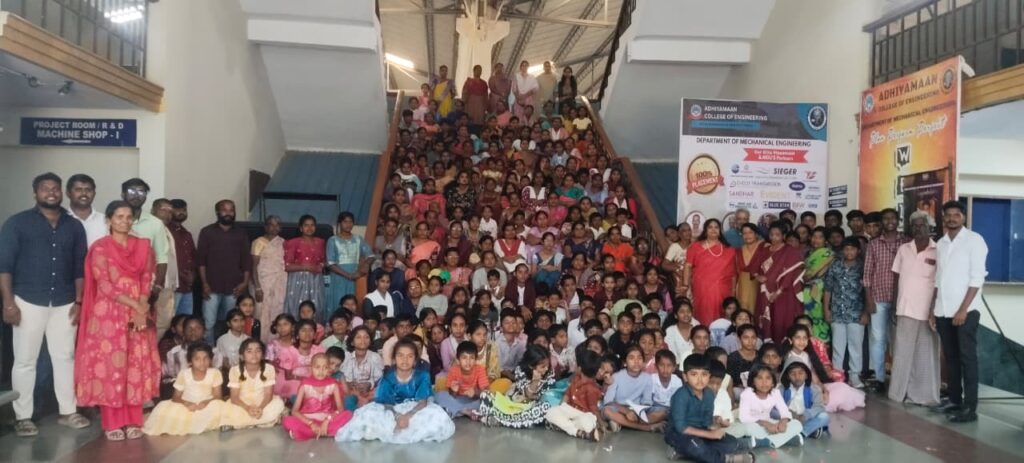
It was the day after a large parents’ meeting organised at Hosur, attended by an astonishing 260 people. This meeting covered families from Krishnagiri and Dharmapuri districts. The previous such meeting, held in March 2025, had attracted 165 participants. This represented an increase of nearly 58% in attendance over 20 months.
Naturally, we wanted to understand what had brought so many families together. Why were these mothers making the effort to attend? What was motivating them?
The question became even more intriguing when we considered a few facts.
- We had stopped reimbursing travel expenses. The families were paying for their own travel and attending entirely voluntarily.
- Some families had apparently started their journeys as early as 5 am to reach the venue on time. Given the geographical spread of these two districts, this meant getting up early, getting the children ready and undertaking a fairly long journey.
- There was no financial incentive, reward or special benefit promised for attending. In fact, nobody had even asked for one.
So, during our Monday meeting, we went around the group asking our social workers to offer their best guesses on what might be motivating these mothers.
The responses were revealing.
Perhaps Kinship Care has become part of their family.
One social worker observed that the field social workers who regularly visit these families have, over time, become almost like members of the family. The parents’ meeting was therefore not just another programme event. It was a family gathering. How could one even think of missing a family function?
Perhaps this was their way of saying thank you.
Our field social workers travel considerable distances to meet families in their homes, understand their circumstances and support them. Coming to the meeting was perhaps the mothers’ way of reciprocating that effort and expressing their appreciation.
Perhaps they wanted to meet people they had only known from a distance.
Some families had never met their assigned remote social workers or other members of the Kinship Care team in person. The meeting offered an opportunity to put faces to familiar voices, interact and strengthen relationships.
Perhaps they valued the dignity and respect they received.
Regardless of their social or economic circumstances, the Kinship Care social workers treat every mother with the same respect and dignity. Their children are treated no differently from any other child. Perhaps this sense of acceptance, without judgement or discrimination, is itself a reason why the mothers feel so comfortable being part of Kinship Care.
Perhaps they saw this as an opportunity for their children.
The mothers were aware that Kinship Care offers several programmes and forms of support beyond the regular assistance they receive. They wanted to know more and ensure that their children did not miss out on any opportunity.
For these mothers, many of whom are bringing up their children after losing their partners, the growth, development and well-being of their children matter more than anything else.
As the meeting progressed, the social workers who had attended the Hosur gathering shared more observations. They spoke about the warmth, enthusiasm and strong sense of belonging displayed by the families. It was evident not merely in what the mothers said, but also in their behaviour, their interactions and the way they engaged with the team throughout the gathering.
Listening to all this set me thinking.
Isn’t this an extraordinary response from the mothers?
We started Kinship Care with the intention of supporting children who had lost one or both parents, helping them continue to grow up within their families and communities rather than in institutional care. Over time, we have developed systems for financial support, social work interventions, individual child plans, educational assistance and several other initiatives.
We measure our progress through the number of children supported, families reached, educational outcomes, improvements in well-being and other programme indicators. These are important, and we must continue to measure them.
But are we adequately capturing another dimension of our impact?
What does it mean when a mother, with no financial obligation or incentive to attend, is willing to get up early, get her children ready, spend hours travelling and come to a meeting simply because she wants to be there?
What does it mean when a social worker is no longer seen as someone who comes to deliver a service, but as someone who belongs to the family?
And what does it mean when families begin to see the programme not as an external source of assistance, but as a community of people who genuinely care about their children and their future?
Perhaps we are witnessing something more valuable than the sum of the individual interventions we provide.
We often talk about the impact of Kinship Care in terms of the children we reach and the support we provide. But perhaps one of its less visible achievements is the network of trust, relationships, reciprocity and belonging that has developed around these families.
Perhaps the sense of commitment and belonging that we see within our own team has gradually extended to the families as well. What started as a programme to support families may have evolved into a community that they feel they belong to.
This is difficult to quantify. It may not appear in our monthly reports or programme dashboards. Yet it could well be one of the most enduring outcomes of Kinship Care.
Perhaps this too, is a Kinship Miracle.

Comment (1)
So true. Thank you